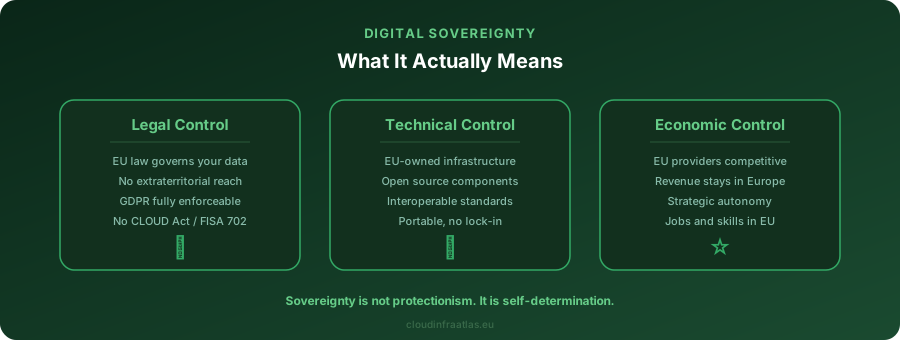
Digital Sovereignty: What It Actually Means
Digital sovereignty has become the defining concept in European technology policy, but it is frequently reduced to a slogan. In practice, sovereignty means the capacity to make autonomous decisions about technology — encompassing data residency, legal jurisdiction, supply-chain control, interoperability, and the institutional ability to switch providers without catastrophic disruption.
Key Takeaways
- The European Commission's 2020 digital strategy placed "technological sovereignty" alongside the green transition as a defining policy objective, embedding it across regulations from the Data Act to the AI Act.
- Sovereignty is multi-layered: it encompasses legal jurisdiction (whose laws apply to your data), operational control (who runs your infrastructure), technical portability (can you leave), and strategic autonomy (can you build alternatives).
- France, Germany, and the Netherlands have each developed distinct national approaches to digital sovereignty — from SecNumCloud to the Sovereign Tech Fund to the Dutch government's open-source-first strategy.
- Practical sovereignty requires exit strategies: contractual, technical, and organisational measures that ensure switching providers is difficult but not catastrophic.
From Buzzword to Policy Framework
The term "digital sovereignty" entered mainstream European policy discourse around 2019-2020, driven by the convergence of several forces: the Snowden revelations (2013), the Schrems judgments (2015, 2020), escalating US-China tech competition, the CLOUD Act (2018), and the COVID-19 pandemic's exposure of Europe's dependence on non-EU digital infrastructure for critical services.
In February 2020, the European Commission published its communication "Shaping Europe's Digital Future", placing "technological sovereignty" alongside sustainability as a core pillar of EU digital strategy. This was operationalised through a cascade of legislative initiatives: the Data Governance Act (Regulation (EU) 2022/868), the Data Act (Regulation (EU) 2023/2854), the AI Act (Regulation (EU) 2024/1689), and the Digital Markets Act — each embedding sovereignty-adjacent requirements around data portability, interoperability, and jurisdictional control.
The European Council has reinforced this trajectory. In October 2020, EU leaders adopted conclusions on "Europe's Digital Sovereignty", calling for reduced strategic dependencies in key technology areas. By 2024, sovereignty had become a lens through which virtually all EU technology policy was evaluated — from semiconductor supply chains (European Chips Act) to cloud certification (EUCS) to critical raw materials.
The Layers of Sovereignty
Digital sovereignty is not a binary state. It operates across multiple interdependent layers, each of which must be assessed when evaluating an organisation's autonomy over its digital infrastructure:
- Legal sovereignty (jurisdiction): Whose laws govern your data and operations? Data stored in the EU by a US-headquartered provider is subject to both EU law (GDPR) and US law (CLOUD Act, FISA 702). True legal sovereignty requires that only EU/EEA law applies — achievable only by using providers incorporated and headquartered exclusively within the EU with no foreign parent company.
- Operational sovereignty (control): Who operates your infrastructure? Even if data sits in an EU data centre, operational control may rest with staff in non-EU locations, or with automated systems managed from a foreign headquarters. France's SecNumCloud 3.2 and the proposed EUCS sovereignty tier specifically address this by requiring EU-based operations and personnel.
- Technical sovereignty (portability): Can you leave? Sovereignty is meaningless if switching providers is technically impossible or prohibitively expensive. This layer encompasses data portability (can you export your data in standard formats?), application portability (is your workload containerised and cloud-agnostic?), and API portability (do you rely on proprietary managed services with no equivalent elsewhere?).
- Strategic sovereignty (capacity): Can Europe build and sustain alternatives? This encompasses industrial policy, R&D investment, skills development, and the health of the European technology ecosystem. A continent that cannot produce competitive cloud infrastructure, AI models, or semiconductor designs cannot achieve durable sovereignty regardless of regulatory frameworks.
National Approaches Across Europe
While the EU sets the regulatory framework, sovereignty strategies are implemented at the national level, and approaches vary significantly:
France has adopted the most aggressive sovereignty posture. ANSSI's SecNumCloud 3.2 qualification, effective since 2022, requires that certified cloud providers be majority-owned by EU entities, headquartered in the EU, and immune from non-EU jurisdictions. The French government mandated SecNumCloud-qualified providers for all sensitive public-sector workloads through a 2023 circular. French providers OVHcloud, Outscale (Dassault Systèmes), and 3DS Outscale have obtained or are pursuing qualification.
Germany has taken a dual approach. The BSI's C5 criteria catalogue provides a technical security standard without explicit sovereignty requirements, while industrial policy focuses on building capacity through initiatives like the Sovereign Tech Fund — established in 2022 with €67.5 million to fund open-source digital infrastructure projects. Germany also championed the Gaia-X initiative, launched jointly with France in 2019 as a federated data infrastructure framework.
The Netherlands has focused on open standards and open source as sovereignty levers. The Dutch government's open-source-first policy requires public bodies to consider open-source alternatives before procuring proprietary software. Dutch municipalities have been among the most active in Europe in deploying Nextcloud, Element/Matrix, and other open-source collaboration tools to reduce dependence on US SaaS platforms.
Exit Strategies: The Practical Test of Sovereignty
The ultimate test of digital sovereignty is not where your data sits today, but whether you can move it tomorrow. An exit strategy — the documented, tested, and resourced ability to migrate away from a provider — is what separates genuine sovereignty from the appearance of it.
The EU's Data Act (Regulation (EU) 2023/2854), which became applicable on 12 September 2025, directly addresses this. Articles 23-31 impose obligations on cloud providers to facilitate switching and interoperability, including:
- Providing switching assistance (technical support, documentation, data exports) to customers at no charge beyond the direct cost of the switching process
- Eliminating switching charges entirely after a transitional period (maximum 3 years from the Act's application)
- Ensuring functional equivalence for data exports — customers must receive their data in formats that allow import into alternative services
- Complying with open interoperability specifications for common cloud service types
Beyond legal obligations, practical exit capability requires architectural discipline from the start. This means containerising workloads (Kubernetes, OCI-compliant runtimes), using infrastructure-as-code (Terraform, OpenTofu) with provider-agnostic patterns, avoiding deep integration with proprietary managed services where open-source equivalents exist, and regularly testing migration playbooks — not as a theoretical exercise but as a periodic operational drill.
Organisations that invest in exit capability gain negotiating leverage, regulatory compliance, and genuine resilience. Those that don't discover the true cost of lock-in only when they need to leave — and by then, the switching costs may be prohibitive.
For the practical side of switching costs, see our analysis of vendor lock-in with US hyperscalers. To understand the financial incentives keeping startups on US cloud, read how EU startups are supposed to quit US cloud. And for real-world examples of organisations that made the switch, see our migration success stories.
Frequently Asked Questions
What is digital sovereignty?
Digital sovereignty is the capacity of a state, organisation, or individual to make autonomous decisions about their technology. In practice, it encompasses data residency, legal jurisdiction, supply-chain control, interoperability, and the ability to switch providers without catastrophic disruption.
Why does digital sovereignty matter for European businesses?
European businesses relying on US-controlled infrastructure face risks from extraterritorial laws (CLOUD Act, FISA 702), vendor lock-in, and geopolitical instability. Digital sovereignty ensures organisations maintain control over their data, reduce regulatory risk, and avoid dependence on foreign jurisdictions.
How can organisations achieve digital sovereignty?
Key steps include choosing EU-headquartered cloud providers, using open standards and open-source software to avoid lock-in, maintaining credible exit strategies, ensuring data residency within EU borders, and building internal capability to manage critical infrastructure independently.