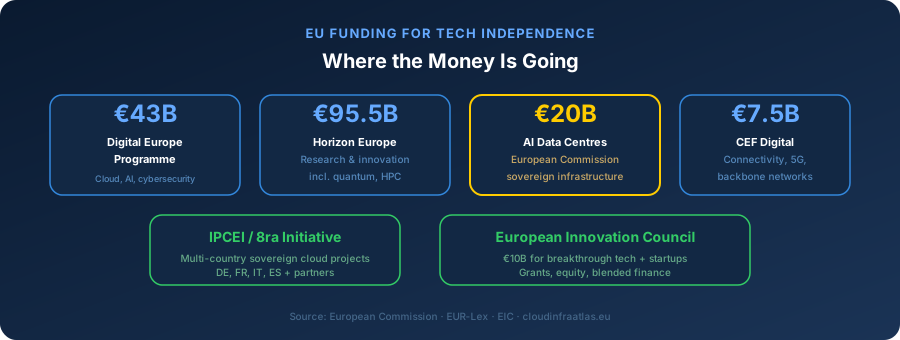
EU Funding for Tech Independence
The European Union and its Member States are channelling billions of euros into cloud infrastructure, AI, semiconductors, and digital public services through programmes including IPCEI Cloud, the Digital Europe Programme, Horizon Europe, and national sovereign tech initiatives. This industrial policy represents Europe's most ambitious attempt to close the technology gap with US and Chinese competitors.
Key Takeaways
- The IPCEI on Next Generation Cloud Infrastructure and Services (IPCEI-CIS), approved in December 2023, mobilises €1.2 billion in public funding across seven Member States to develop European cloud and edge infrastructure.
- The Digital Europe Programme (2021-2027) allocates €7.5 billion for digital capacity-building including cloud, AI, cybersecurity, and advanced digital skills.
- Horizon Europe dedicates €15.3 billion to its Digital, Industry and Space cluster, funding foundational research in cloud-edge computing, AI, and data technologies.
- National programmes — including France's €1.8 billion cloud strategy, Germany's Sovereign Tech Fund, and the Nordic-Baltic digital cooperation — complement EU-level instruments with targeted sovereignty investments.
IPCEI Cloud: European Industrial Cloud Strategy
The Important Project of Common European Interest on Next Generation Cloud Infrastructure and Services (IPCEI-CIS) was approved by the European Commission on 5 December 2023 under EU State aid rules. The project brings together 19 companies from seven Member States — France, Germany, Hungary, Italy, the Netherlands, Poland, and Spain — with the objective of developing the first European interoperable and open-source cloud-edge continuum.
The total public funding amounts to approximately €1.2 billion, expected to unlock an additional €1.4 billion in private investment. Key participants include Atos/Eviden, Deutsche Telekom/T-Systems, IONOS, Orange, Engineering Ingegneria Informatica, and Gigas, among others. The project covers the full cloud-edge stack: hardware (energy-efficient processors, smart network interface cards), middleware (cloud orchestration, containerisation, federated data processing), and applications (industry-specific cloud services for healthcare, manufacturing, and public administration).
The IPCEI-CIS is explicitly designed to reduce Europe's dependency on non-EU cloud providers. The Commission's approval decision emphasised that the project addresses a market failure — European companies hold less than 10% of the global cloud infrastructure market — and that the resulting technologies will be made available on fair, reasonable, and non-discriminatory (FRAND) terms, with commitments to open-source key components.
The Digital Europe Programme
The Digital Europe Programme (DIGITAL), established by Regulation (EU) 2021/694, is the EU's first dedicated funding programme for digital capacity-building. With a total budget of €7.5 billion for 2021-2027, it is structured around five pillars:
- Supercomputing (€2.2 billion): Funding for EuroHPC Joint Undertaking, including exascale and quantum computing infrastructure across Member States.
- Artificial Intelligence (€2.1 billion): Testing and Experimentation Facilities, AI-on-demand platforms, and sector-specific AI solutions for public and private use.
- Cybersecurity (€1.6 billion): European Cybersecurity Competence Centre, national coordination centres, and deployment of EU-certified security tools including sovereign cloud infrastructure.
- Advanced Digital Skills (€577 million): Specialised training programmes and master's courses in AI, cybersecurity, and cloud computing.
- Digital Transformation (€1.1 billion): European Digital Innovation Hubs, interoperable digital public services, and government technology modernisation.
Within the cybersecurity and digital transformation pillars, DIGITAL directly funds the deployment of sovereign cloud infrastructure for public administrations. Work programmes for 2023-2024 included calls for European cloud marketplace development, cloud-to-edge middleware deployment, and cross-border digital government services hosted on EU-sovereign platforms. The programme complements, rather than replaces, national cloud strategies by providing co-funding and cross-border coordination.
Horizon Europe and Research Foundations
Horizon Europe, the EU's framework programme for research and innovation (2021-2027), dedicates €15.3 billion to its Cluster 4: "Digital, Industry and Space." Within this cluster, multiple work programmes fund foundational research in areas critical to digital sovereignty:
- Cloud-edge computing: Projects developing federated cloud architectures, edge computing middleware, and interoperability frameworks — directly feeding into the IPCEI-CIS industrial deployment.
- AI and data: Large-scale research projects on foundation models, trustworthy AI, and European data spaces for sectors from healthcare to mobility.
- Cybersecurity: Research into post-quantum cryptography, secure multi-party computation, and zero-trust architectures for European cloud infrastructure.
- Open-source ecosystems: Horizon Europe funds have supported the development and maintenance of critical open-source infrastructure through projects like NGI (Next Generation Internet), which has funded hundreds of open-source software projects since 2018.
The pipeline from Horizon Europe research to IPCEI industrial deployment to Digital Europe rollout represents a coherent (if sometimes slow) innovation pathway. However, critics note that Europe's track record of converting research excellence into commercial success remains mixed — the continent produces world-class research in AI, quantum computing, and data technologies, but struggles to scale startups into global competitors.
National Programmes and Sovereign Tech Investments
Member States have launched their own sovereignty-oriented technology programmes, often complementing EU funding:
France announced a €1.8 billion national cloud strategy in 2021, co-led by the Direction interministérielle du numérique (DINUM) and the Secrétariat général pour l'investissement. The strategy includes direct investment in sovereign cloud providers, mandatory use of SecNumCloud-qualified services for sensitive government workloads, and R&D funding for cloud-edge technologies through France 2030. OVHcloud, 3DS Outscale, and Scaleway are primary beneficiaries.
Germany's Sovereign Tech Fund, established in 2022 with initial funding of €67.5 million from the Federal Ministry for Economic Affairs and Climate Action (BMWK), takes a different approach: it funds the maintenance and development of open-source software that constitutes critical digital infrastructure. Projects funded include curl, OpenSSL, PHP, WireGuard, and Log4j — the unglamorous but essential codebases that underpin European and global digital systems. The fund received additional financing in 2023 and has become a model for other countries.
The Nordic-Baltic region has pursued digital sovereignty through cross-border cooperation rather than purely national strategies. The Nordic Council of Ministers' digitalisation programme supports shared cloud infrastructure, common digital identity frameworks, and joint procurement of sovereign alternatives. Estonia's e-Residency programme and Finland's MyData initiative contribute to a Nordic-Baltic approach that emphasises data portability and citizen control over personal data.
Together, these national and EU-level programmes represent an unprecedented level of public investment in European technology independence. Whether this investment translates into competitive, self-sustaining European alternatives to US hyperscalers will be the defining question for European digital policy over the next decade.
For a look at why this funding matters at the startup level, see how EU startups are supposed to quit US cloud. To understand the lock-in dynamics that public funding needs to overcome, read our analysis of vendor lock-in with US hyperscalers.
Frequently Asked Questions
Is the EU funding European cloud infrastructure?
Yes. The EU is investing billions through IPCEI Cloud (multi-billion euro Important Project of Common European Interest), the Digital Europe Programme (7.5 billion euros for 2021-2027), Horizon Europe research grants, and national sovereign tech initiatives across Member States.
What is IPCEI Cloud?
IPCEI Cloud is an Important Project of Common European Interest focused on next-generation cloud and edge computing infrastructure. It allows EU Member States to provide state aid to European cloud projects that would otherwise be prohibited under competition rules, enabling investment in sovereign cloud capabilities.
Can European startups get EU funding for cloud technology?
Yes. European cloud and digital infrastructure startups can access funding through Horizon Europe, the European Innovation Council (EIC), the Digital Europe Programme, and national funding programmes. The EU has made closing the technology gap with US and Chinese competitors an explicit policy priority.