Migration Success Stories
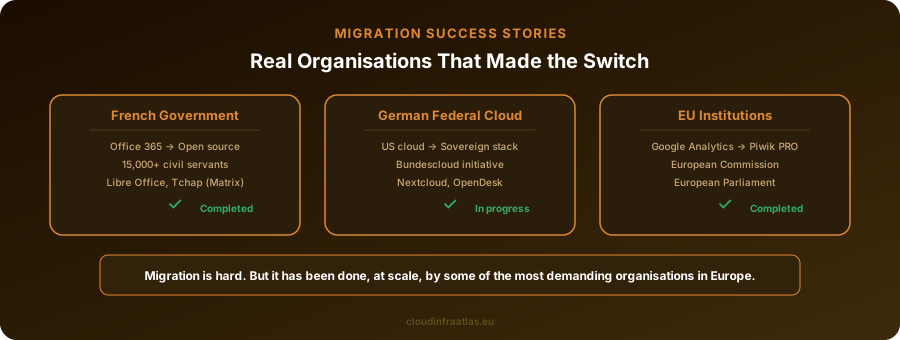
European organisations — from national governments to municipalities to fast-growing startups — have successfully migrated off US platforms to European alternatives. These case studies demonstrate that migration is not only feasible but often delivers tangible benefits: lower compliance overhead, better data control, reduced costs, and genuine operational independence.
Key Takeaways
- The French government migrated 300,000+ civil servants from Microsoft Teams to an internally hosted Tchap messaging platform built on the Matrix protocol, achieving sovereign communications across all ministries.
- The German state of Schleswig-Holstein committed in 2024 to migrating 25,000 government workstations from Microsoft Office to LibreOffice and from Windows to Linux, following a detailed cost-benefit and sovereignty analysis.
- The city of Munich's "LiMux" project (2003-2017) migrated 15,000 desktops to Linux and LibreOffice before being reversed — and then partially reinstated — offering enduring lessons about political, not technical, barriers to migration.
- European startups including Proton (Switzerland), Nextcloud (Germany), and Filen (Germany) have built privacy-first products that serve millions of users with exclusively European infrastructure.
France: Sovereign Messaging for 300,000 Civil Servants
In 2018, the French government's Digital Affairs Directorate (DINUM) launched Tchap, a sovereign instant-messaging platform for all French civil servants. Built on the open-source Matrix protocol and deployed on government-controlled infrastructure, Tchap replaced the ad hoc use of consumer messaging apps (WhatsApp, Telegram) and commercial platforms (Slack, Microsoft Teams) that could not guarantee data sovereignty.
By 2024, Tchap served over 300,000 users across all French government ministries, agencies, and territorial administrations. The platform provides end-to-end encrypted messaging, file sharing, and voice/video calls, with all data processed exclusively on French government servers. No metadata is shared with or accessible by any non-French entity.
The success of Tchap rested on several strategic decisions. First, choosing an open protocol (Matrix) rather than building from scratch allowed rapid development while maintaining full control over the server implementation. Second, DINUM made adoption mandatory for certain communication categories — any discussion involving classified or sensitive government information must use Tchap, not commercial alternatives. Third, the project invested heavily in user experience, iterating the client application based on feedback from actual civil servants rather than assuming adoption would follow from a mandate alone.
France extended this approach further with the Suite numérique collaborative de l'État, a sovereign digital workplace integrating messaging (Tchap), email, calendaring, document collaboration, and video conferencing — all hosted on French government infrastructure.
Schleswig-Holstein: 25,000 Desktops Moving to Linux and LibreOffice
In April 2024, the German state of Schleswig-Holstein formally announced its decision to migrate 25,000 government workstations from Microsoft Windows and Office to Linux and LibreOffice, with the project to be completed by 2027. The migration also encompasses replacing Microsoft SharePoint with Nextcloud, Microsoft Exchange/Outlook with Open-Xchange, and Microsoft Active Directory with open-source identity management.
The decision followed a comprehensive sovereignty and cost-benefit analysis conducted over 2022-2023. The state's Digital Minister, Dirk Schrödter, cited three primary drivers: digital sovereignty (ensuring that the state's IT infrastructure is not dependent on decisions made by a US corporation), cost predictability (avoiding recurring licence-fee increases and unpredictable pricing model changes), and GDPR compliance (eliminating telemetry data flows to Microsoft servers outside the state's control).
Schleswig-Holstein explicitly learned from the Munich experience (see below) and structured its migration to address the political and organisational factors that had derailed earlier efforts. The state appointed dedicated migration teams within each ministry, established a central open-source competence centre, and committed to a parallel-running period during which both Microsoft and open-source tools would be available, avoiding a disruptive "big bang" switch.
Munich: The LiMux Saga and Its Lessons
No discussion of European migration success stories is complete without Munich's LiMux project — the most famous (and controversial) open-source migration in European government IT history. In 2003, the city of Munich voted to migrate its 15,000 desktop computers from Windows NT and Microsoft Office to a custom Linux distribution (LiMux, based on Ubuntu) and LibreOffice.
The technical migration was largely complete by 2013. By the city's own assessment, LiMux was running successfully on over 15,000 workstations, with approximately 80% of applications either replaced with open-source alternatives or running via compatibility layers. A 2012 city council report estimated cumulative savings of over €10 million compared to the projected cost of Windows and Office licence renewals.
However, in 2017, the newly elected city government voted to reverse the migration and return to Windows 10 and Microsoft Office, citing user complaints about compatibility issues (particularly with external partners using Microsoft formats), fragmentation across city departments, and difficulty recruiting IT staff familiar with the LiMux environment. Microsoft's decision to relocate its German headquarters to Munich in 2016 was widely noted, though the company denied any connection to the policy reversal.
The story didn't end there. In 2020, Munich's new coalition government partially reversed the reversal, committing to an open-source-first strategy and the use of "Public Money, Public Code" principles for future software procurement. The LiMux saga's enduring lesson is that large-scale migration is technically feasible but politically vulnerable — success requires sustained institutional commitment that survives electoral cycles, not just a one-time council vote.
European Companies Building Privacy-First Alternatives
The migration story extends beyond governments. A growing ecosystem of European companies has built products that serve as privacy-first, EU-sovereign alternatives to US platforms:
- Proton (Geneva, Switzerland): Founded in 2014 by CERN researchers, Proton offers end-to-end encrypted email (Proton Mail), cloud storage (Proton Drive), VPN, calendar, and password management — all hosted exclusively in Switzerland. With over 100 million accounts by 2024, Proton has demonstrated that privacy-first European products can achieve global scale.
- Nextcloud (Stuttgart, Germany): The leading open-source self-hosted collaboration platform, used by the German federal government, French administration, Swedish public agencies, and hundreds of European enterprises. Nextcloud Hub provides file sync, document editing (via Collabora or OnlyOffice), calendaring, video calls, and project management — a self-hosted alternative to Microsoft 365 and Google Workspace.
- Element (London, UK): The company behind the Matrix protocol, providing encrypted messaging and collaboration for NATO, the German Bundeswehr, the French government (Tchap), and the UK Ministry of Defence. Element demonstrates that open-source, decentralised communications can meet the most demanding security and sovereignty requirements.
- Hetzner (Gunzenhausen, Germany): A cloud and dedicated-server provider that has become the de facto infrastructure choice for European startups and developers seeking transparent pricing, zero egress fees, and EU-only data residency. Hetzner's cloud offerings — VMs, load balancers, object storage, managed Kubernetes — compete directly with AWS and Azure at a fraction of the cost.
These companies prove that the "European alternative doesn't exist" narrative is increasingly outdated. For many workloads — collaboration, messaging, email, storage, compute, databases — capable, mature, European-built and European-hosted options are available today.
To understand the role of open-source in enabling these migrations, see open source as a sovereignty lever. For the financial barriers that still keep most startups on US cloud, read how EU startups are supposed to quit US cloud.
Frequently Asked Questions
Can you migrate from AWS to a European cloud provider?
Yes. European organisations including national governments, municipalities, and startups have successfully migrated from AWS, Azure, and Google Cloud to European alternatives. Migration typically involves containerising workloads, using infrastructure-as-code, and phased cutover strategies.
How long does it take to migrate from US to EU cloud?
Migration timelines vary by complexity. Simple web applications can be migrated in days to weeks. Enterprise workloads with multiple dependencies typically take 3 to 12 months. The key success factors are thorough planning, containerisation, and avoiding the temptation to migrate everything at once.
Is European cloud infrastructure reliable enough for production?
Absolutely. European providers like Hetzner, OVHcloud, and Scaleway offer enterprise-grade SLAs (99.9%+), redundant infrastructure, and competitive performance. Many organisations report lower costs and better support after migrating from US hyperscalers.